 Add to Chrome
 Add to Firefox
 Add to Edge
UniT: Unified Multimodal Chain-of-Thought Test-time Scaling
Feb 12, 2026
Unified models can handle both multimodal understanding and generation within a single architecture, yet they typically operate in a single pass without iteratively refining their outputs. Many multimodal tasks, especially those involving complex spatial compositions, multiple interacting objects, or evolving instructions, require decomposing instructions, verifying intermediate results, and making iterative corrections. While test-time scaling (TTS) has demonstrated that allocating additional inference compute for iterative reasoning substantially improves language model performance, extending this paradigm to unified multimodal models remains an open challenge. We introduce UniT, a framework for multimodal chain-of-thought test-time scaling that enables a single unified model to reason, verify, and refine across multiple rounds. UniT combines agentic data synthesis, unified model training, and flexible test-time inference to elicit cognitive behaviors including verification, subgoal decomposition, and content memory. Our key findings are: (1) unified models trained on short reasoning trajectories generalize to longer inference chains at test time; (2) sequential chain-of-thought reasoning provides a more scalable and compute-efficient TTS strategy than parallel sampling; (3) training on generation and editing trajectories improves out-of-distribution visual reasoning. These results establish multimodal test-time scaling as an effective paradigm for advancing both generation and understanding in unified models.

Non-Markov Multi-Round Conversational Image Generation with History-Conditioned MLLMs
Jan 28, 2026Conversational image generation requires a model to follow user instructions across multiple rounds of interaction, grounded in interleaved text and images that accumulate as chat history. While recent multimodal large language models (MLLMs) can generate and edit images, most existing multi-turn benchmarks and training recipes are effectively Markov: the next output depends primarily on the most recent image, enabling shortcut solutions that ignore long-range history. In this work we formalize and target the more challenging non-Markov setting, where a user may refer back to earlier states, undo changes, or reference entities introduced several rounds ago. We present (i) non-Markov multi-round data construction strategies, including rollback-style editing that forces retrieval of earlier visual states and name-based multi-round personalization that binds names to appearances across rounds; (ii) a history-conditioned training and inference framework with token-level caching to prevent multi-round identity drift; and (iii) enabling improvements for high-fidelity image reconstruction and editable personalization, including a reconstruction-based DiT detokenizer and a multi-stage fine-tuning curriculum. We demonstrate that explicitly training for non-Markov interactions yields substantial improvements in multi-round consistency and instruction compliance, while maintaining strong single-round editing and personalization.
The Llama 4 Herd: Architecture, Training, Evaluation, and Deployment Notes
Jan 15, 2026This document consolidates publicly reported technical details about Metas Llama 4 model family. It summarizes (i) released variants (Scout and Maverick) and the broader herd context including the previewed Behemoth teacher model, (ii) architectural characteristics beyond a high-level MoE description covering routed/shared-expert structure, early-fusion multimodality, and long-context design elements reported for Scout (iRoPE and length generalization strategies), (iii) training disclosures spanning pre-training, mid-training for long-context extension, and post-training methodology (lightweight SFT, online RL, and lightweight DPO) as described in release materials, (iv) developer-reported benchmark results for both base and instruction-tuned checkpoints, and (v) practical deployment constraints observed across major serving environments, including provider-specific context limits and quantization packaging. The manuscript also summarizes licensing obligations relevant to redistribution and derivative naming, and reviews publicly described safeguards and evaluation practices. The goal is to provide a compact technical reference for researchers and practitioners who need precise, source-backed facts about Llama 4.
PhyGDPO: Physics-Aware Groupwise Direct Preference Optimization for Physically Consistent Text-to-Video Generation
Dec 31, 2025Recent advances in text-to-video (T2V) generation have achieved good visual quality, yet synthesizing videos that faithfully follow physical laws remains an open challenge. Existing methods mainly based on graphics or prompt extension struggle to generalize beyond simple simulated environments or learn implicit physical reasoning. The scarcity of training data with rich physics interactions and phenomena is also a problem. In this paper, we first introduce a Physics-Augmented video data construction Pipeline, PhyAugPipe, that leverages a vision-language model (VLM) with chain-of-thought reasoning to collect a large-scale training dataset, PhyVidGen-135K. Then we formulate a principled Physics-aware Groupwise Direct Preference Optimization, PhyGDPO, framework that builds upon the groupwise Plackett-Luce probabilistic model to capture holistic preferences beyond pairwise comparisons. In PhyGDPO, we design a Physics-Guided Rewarding (PGR) scheme that embeds VLM-based physics rewards to steer optimization toward physical consistency. We also propose a LoRA-Switch Reference (LoRA-SR) scheme that eliminates memory-heavy reference duplication for efficient training. Experiments show that our method significantly outperforms state-of-the-art open-source methods on PhyGenBench and VideoPhy2. Please check our project page at https://caiyuanhao1998.github.io/project/PhyGDPO for more video results. Our code, models, and data will be released at https://github.com/caiyuanhao1998/Open-PhyGDPO
Token-Shuffle: Towards High-Resolution Image Generation with Autoregressive Models
Apr 24, 2025Autoregressive (AR) models, long dominant in language generation, are increasingly applied to image synthesis but are often considered less competitive than Diffusion-based models. A primary limitation is the substantial number of image tokens required for AR models, which constrains both training and inference efficiency, as well as image resolution. To address this, we present Token-Shuffle, a novel yet simple method that reduces the number of image tokens in Transformer. Our key insight is the dimensional redundancy of visual vocabularies in Multimodal Large Language Models (MLLMs), where low-dimensional visual codes from visual encoder are directly mapped to high-dimensional language vocabularies. Leveraging this, we consider two key operations: token-shuffle, which merges spatially local tokens along channel dimension to decrease the input token number, and token-unshuffle, which untangles the inferred tokens after Transformer blocks to restore the spatial arrangement for output. Jointly training with textual prompts, our strategy requires no additional pretrained text-encoder and enables MLLMs to support extremely high-resolution image synthesis in a unified next-token prediction way while maintaining efficient training and inference. For the first time, we push the boundary of AR text-to-image generation to a resolution of 2048x2048 with gratifying generation performance. In GenAI-benchmark, our 2.7B model achieves 0.77 overall score on hard prompts, outperforming AR models LlamaGen by 0.18 and diffusion models LDM by 0.15. Exhaustive large-scale human evaluations also demonstrate our prominent image generation ability in terms of text-alignment, visual flaw, and visual appearance. We hope that Token-Shuffle can serve as a foundational design for efficient high-resolution image generation within MLLMs.
MoCha: Towards Movie-Grade Talking Character Synthesis
Mar 30, 2025
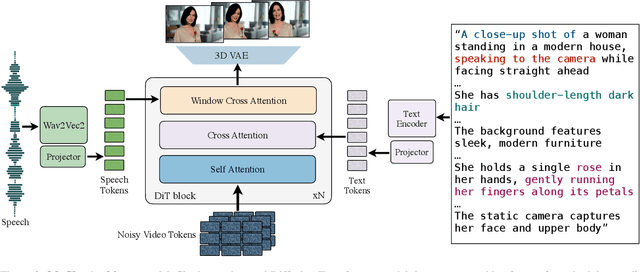
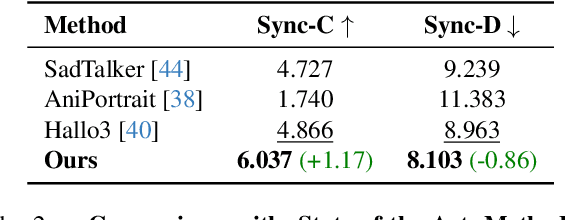
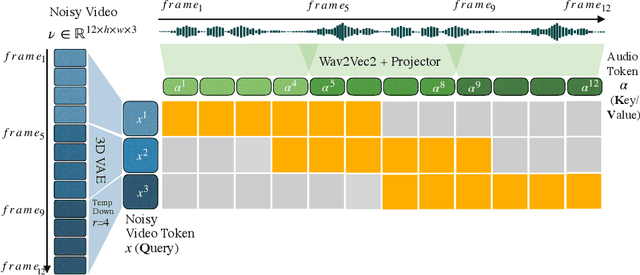
Recent advancements in video generation have achieved impressive motion realism, yet they often overlook character-driven storytelling, a crucial task for automated film, animation generation. We introduce Talking Characters, a more realistic task to generate talking character animations directly from speech and text. Unlike talking head, Talking Characters aims at generating the full portrait of one or more characters beyond the facial region. In this paper, we propose MoCha, the first of its kind to generate talking characters. To ensure precise synchronization between video and speech, we propose a speech-video window attention mechanism that effectively aligns speech and video tokens. To address the scarcity of large-scale speech-labeled video datasets, we introduce a joint training strategy that leverages both speech-labeled and text-labeled video data, significantly improving generalization across diverse character actions. We also design structured prompt templates with character tags, enabling, for the first time, multi-character conversation with turn-based dialogue-allowing AI-generated characters to engage in context-aware conversations with cinematic coherence. Extensive qualitative and quantitative evaluations, including human preference studies and benchmark comparisons, demonstrate that MoCha sets a new standard for AI-generated cinematic storytelling, achieving superior realism, expressiveness, controllability and generalization.
DirectorLLM for Human-Centric Video Generation
Dec 19, 2024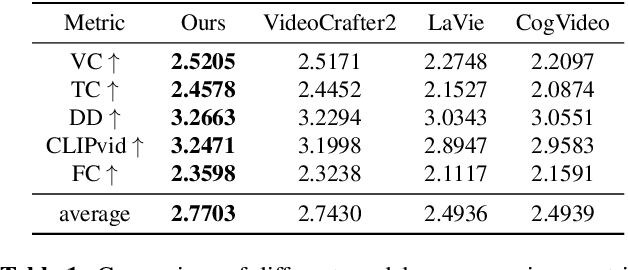
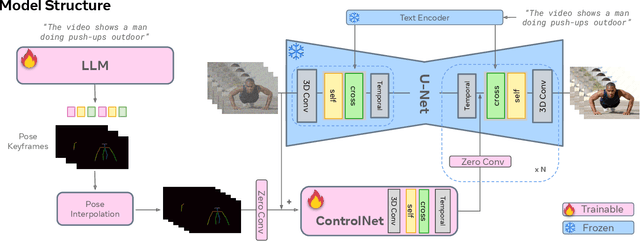
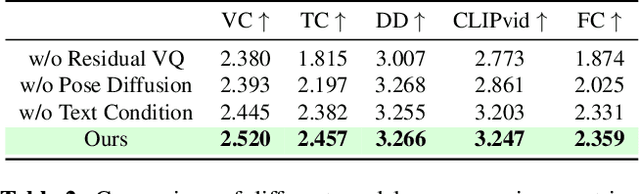

In this paper, we introduce DirectorLLM, a novel video generation model that employs a large language model (LLM) to orchestrate human poses within videos. As foundational text-to-video models rapidly evolve, the demand for high-quality human motion and interaction grows. To address this need and enhance the authenticity of human motions, we extend the LLM from a text generator to a video director and human motion simulator. Utilizing open-source resources from Llama 3, we train the DirectorLLM to generate detailed instructional signals, such as human poses, to guide video generation. This approach offloads the simulation of human motion from the video generator to the LLM, effectively creating informative outlines for human-centric scenes. These signals are used as conditions by the video renderer, facilitating more realistic and prompt-following video generation. As an independent LLM module, it can be applied to different video renderers, including UNet and DiT, with minimal effort. Experiments on automatic evaluation benchmarks and human evaluations show that our model outperforms existing ones in generating videos with higher human motion fidelity, improved prompt faithfulness, and enhanced rendered subject naturalness.
LinGen: Towards High-Resolution Minute-Length Text-to-Video Generation with Linear Computational Complexity
Dec 13, 2024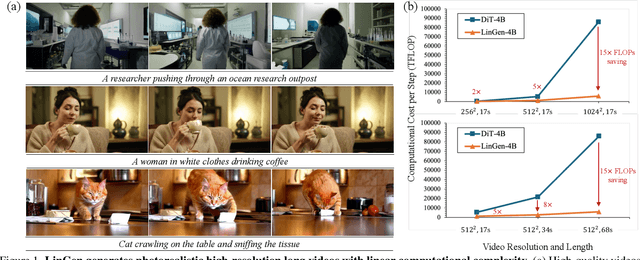
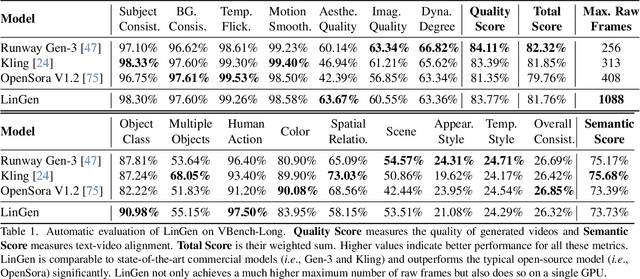
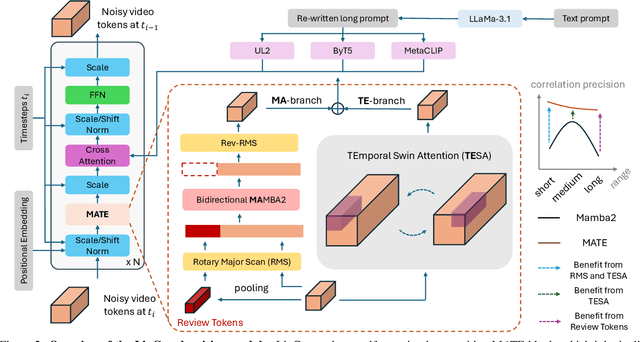
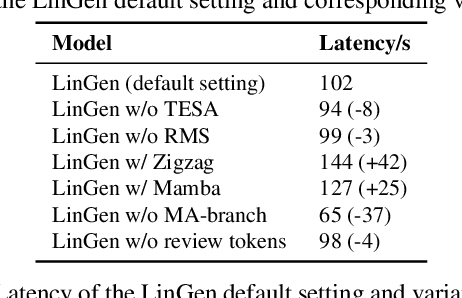
Text-to-video generation enhances content creation but is highly computationally intensive: The computational cost of Diffusion Transformers (DiTs) scales quadratically in the number of pixels. This makes minute-length video generation extremely expensive, limiting most existing models to generating videos of only 10-20 seconds length. We propose a Linear-complexity text-to-video Generation (LinGen) framework whose cost scales linearly in the number of pixels. For the first time, LinGen enables high-resolution minute-length video generation on a single GPU without compromising quality. It replaces the computationally-dominant and quadratic-complexity block, self-attention, with a linear-complexity block called MATE, which consists of an MA-branch and a TE-branch. The MA-branch targets short-to-long-range correlations, combining a bidirectional Mamba2 block with our token rearrangement method, Rotary Major Scan, and our review tokens developed for long video generation. The TE-branch is a novel TEmporal Swin Attention block that focuses on temporal correlations between adjacent tokens and medium-range tokens. The MATE block addresses the adjacency preservation issue of Mamba and improves the consistency of generated videos significantly. Experimental results show that LinGen outperforms DiT (with a 75.6% win rate) in video quality with up to 15$\times$ (11.5$\times$) FLOPs (latency) reduction. Furthermore, both automatic metrics and human evaluation demonstrate our LinGen-4B yields comparable video quality to state-of-the-art models (with a 50.5%, 52.1%, 49.1% win rate with respect to Gen-3, LumaLabs, and Kling, respectively). This paves the way to hour-length movie generation and real-time interactive video generation. We provide 68s video generation results and more examples in our project website: https://lineargen.github.io/.
Unleashing In-context Learning of Autoregressive Models for Few-shot Image Manipulation
Dec 03, 2024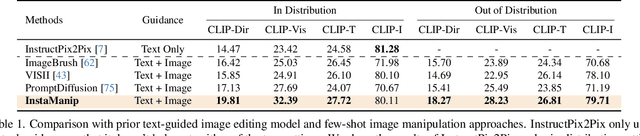
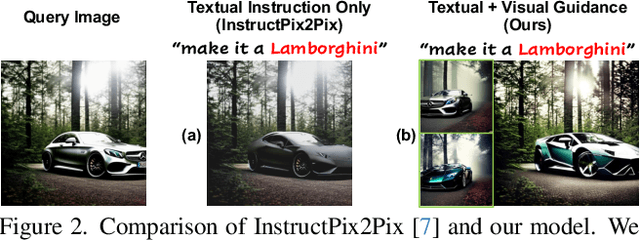

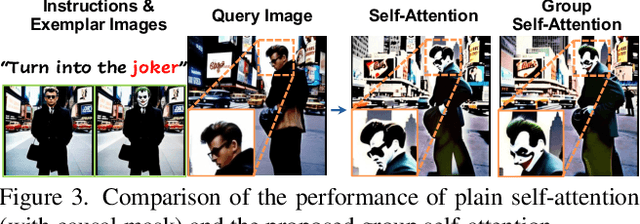
Text-guided image manipulation has experienced notable advancement in recent years. In order to mitigate linguistic ambiguity, few-shot learning with visual examples has been applied for instructions that are underrepresented in the training set, or difficult to describe purely in language. However, learning from visual prompts requires strong reasoning capability, which diffusion models are struggling with. To address this issue, we introduce a novel multi-modal autoregressive model, dubbed $\textbf{InstaManip}$, that can $\textbf{insta}$ntly learn a new image $\textbf{manip}$ulation operation from textual and visual guidance via in-context learning, and apply it to new query images. Specifically, we propose an innovative group self-attention mechanism to break down the in-context learning process into two separate stages -- learning and applying, which simplifies the complex problem into two easier tasks. We also introduce a relation regularization method to further disentangle image transformation features from irrelevant contents in exemplar images. Extensive experiments suggest that our method surpasses previous few-shot image manipulation models by a notable margin ($\geq$19% in human evaluation). We also find our model can be further boosted by increasing the number or diversity of exemplar images.
Towards Automated Model Design on Recommender Systems
Nov 12, 2024The increasing popularity of deep learning models has created new opportunities for developing AI-based recommender systems. Designing recommender systems using deep neural networks requires careful architecture design, and further optimization demands extensive co-design efforts on jointly optimizing model architecture and hardware. Design automation, such as Automated Machine Learning (AutoML), is necessary to fully exploit the potential of recommender model design, including model choices and model-hardware co-design strategies. We introduce a novel paradigm that utilizes weight sharing to explore abundant solution spaces. Our paradigm creates a large supernet to search for optimal architectures and co-design strategies to address the challenges of data multi-modality and heterogeneity in the recommendation domain. From a model perspective, the supernet includes a variety of operators, dense connectivity, and dimension search options. From a co-design perspective, it encompasses versatile Processing-In-Memory (PIM) configurations to produce hardware-efficient models. Our solution space's scale, heterogeneity, and complexity pose several challenges, which we address by proposing various techniques for training and evaluating the supernet. Our crafted models show promising results on three Click-Through Rates (CTR) prediction benchmarks, outperforming both manually designed and AutoML-crafted models with state-of-the-art performance when focusing solely on architecture search. From a co-design perspective, we achieve 2x FLOPs efficiency, 1.8x energy efficiency, and 1.5x performance improvements in recommender models.
* Accepted in ACM Transactions on Recommender Systems. arXiv admin note: substantial text overlap with arXiv:2207.07187